
As I begin this report from Dunbar—the NRCC race point that both opened and closed the 2026 season—I am struck by how quickly the season has passed. By the time this report is published, fanciers will already be getting ready to visit shows, ordering (or ordered!) rings and soon will be preparing for the breeding cycle all over again. It seems time really does pass faster as you get older, but it is this cycle that keep a lot of fanciers young…at heart anyway!
As I write this report, I have been in role as the NRCC Secretary for 6 months, and it is a role I am extremely proud to hold. I recognise the huge amount of work that has taken place to get the NRCC to be the club it is, especially in the dark days of the club’s history, however, I do believe there is still work to be done to continue to move the club forward, work that the officers of the club are working on right now, there is so much that goes on behind the scenes!
I just wanted to take this opportunity to thank the many wonderful people who I have had the opportunity to talk to over these last 6 months and how much I am really looking forward to putting names to faces at the Day of Champions on Saturday 28th September in Spalding.
So, back to racing and Dunbar, I think we all know where this historic Scottish town lies…on the North Sea coast, approximately 30 miles east of Edinburgh and 30 miles from the English border north of Berwick upon Tweed.
For our shorter flying members, Dunbar is a little over 200 miles, whereas members in sections I & H fly over 300 miles.
The NRCC had three races to liberate from Dunbar: the Young Bird, Old Hen and Futurity races. This report covers the Young Bird race; I will report on the Old Hens and the Futurity Race separately.
Marking the three races required almost military precision at all five marking stations! Young birds were marked, basketed and sealed first, followed by the old hens. Futurity birds were marked only after both groups were safely basketed and their crates sealed.
On Friday 11th September, Chris Johnson, the NRCC driver, was waiting with the transporter at Norwich for marking to begin, while the feeder lorry was doing the same at Takeley. As no birds were entered from the Ipswich marking station for the three races, the feeder lorry travelled directly from Takeley back to Wyberton, just outside Boston in Lincolnshire.
Once all the birds had been safely loaded at Norwich, the NRCC transporter also headed back to Wyberton.
At Wyberton, the birds there were marked and loaded using the same procedure, as Norwich and Takeley. The Takeley crates were transferred from the feeder lorry to the transporter. Young Birds were loaded on both sides on the bottom rows, then a row of empty crates, then Old Hens on one side with the Futurity Birds on the other side. The transporter then continued to Calverton to collect the final birds, with Chris driving and NRCC Convoyer David Pettitt on board.
The Calverton birds were loaded, again following the same procedure for marking. The transporter left in the afternoon to make its way up to Dunbar.
After one stop en route, Chris and David arrived with the pigeons at Winterton Park, Dunbar, at 22:15. The birds were, checked, watered and rested before David retired for the night.
The week’s forecast had suggested that a Saturday liberation was unlikely, and Saturday morning came along and confirmed this to be correct. Ray Luffman, the NRCC Weather Advisor, and David Pettitt remained in close contact as usual, and soon agreed that the rain and strong westerly wind would persist all day, and a holdover was needed. With the weather clearly set for the day, there was no reason to delay, and a holdover was announced at 08:00.
By Sunday morning, the weather was improving. Conditions along the line of flight began to clear by 09:00 but needed just a little more time further down the country was needed.
David Pettitt and Ray Luffman stayed in contact throughout the morning and once conditions were good both at the site and along the line of flight, they set the liberation times: Young Bird Race at 10:00, Futurity Bird Race at 10:15 and Old Hen Race at 10:30—the same order as the previous year.
The first race, the NRCC Dunbar Young Bird Race, liberated at 10:00 on Sunday 13th September into a light westerly wind with light variable winds enroute, 83 members sent 1,059 birds.
Here is another first for me, reporting on a race where both the NRCC President and Chairman both admirably topped their sections.
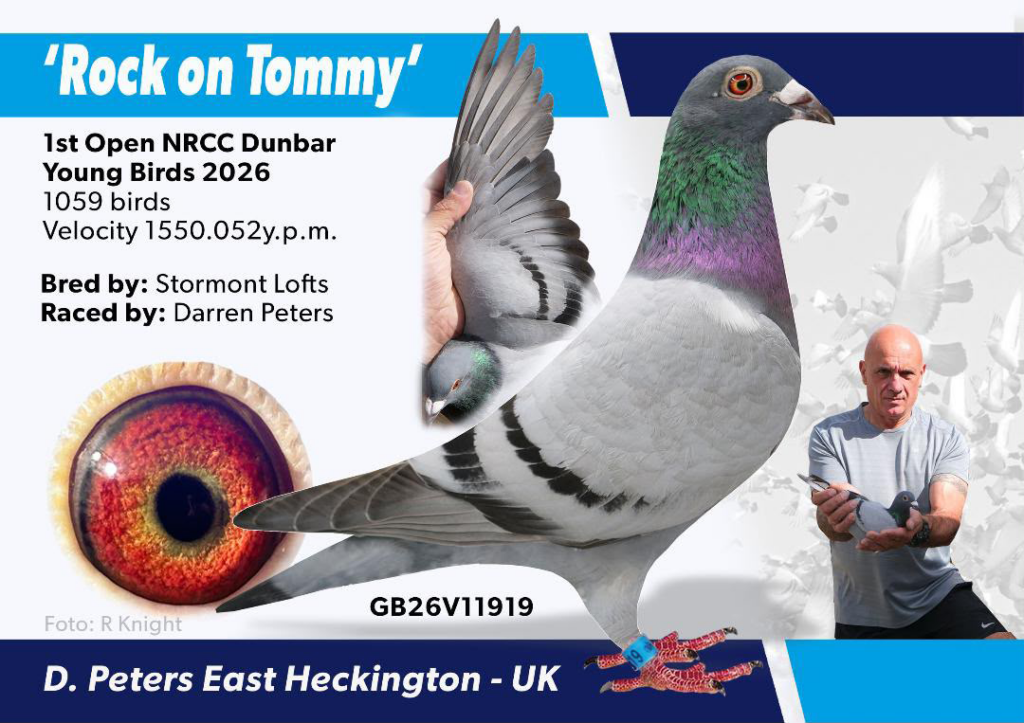
Darren Peters from East Heckington – 1st Open, 1st 2nd 3rd 4th 5th Section B
Flying: 229 miles, 605 yards. Velocity: 1550.0518
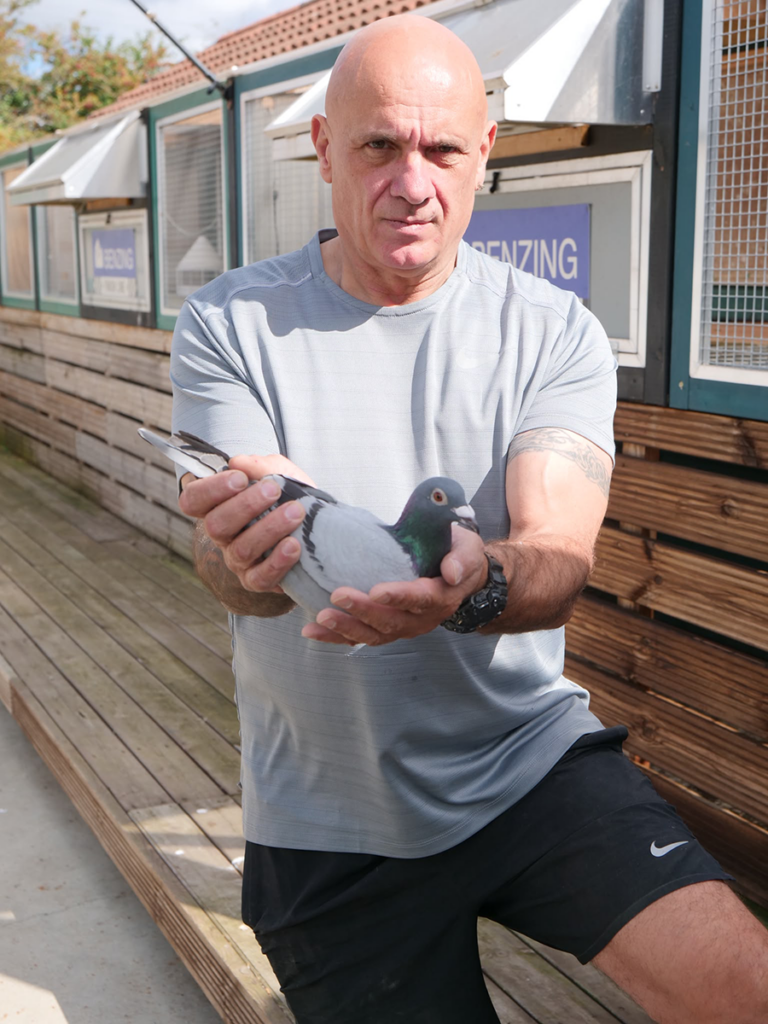
Darren, well known for being a Young Bird specialist, pipped club mates Ray Knight and Joe McFadyen to the top spot in this race.
After verifying Darren’s winning bird, Ray Knight spoke with him and provided the following report:
Darren Peters is no stranger to success when previously racing on the north he has scored many positions with old and young pigeons and was always knocking at the door in the young bird races, one year taking 2nd,3rd, 4th, 5th and 6th.
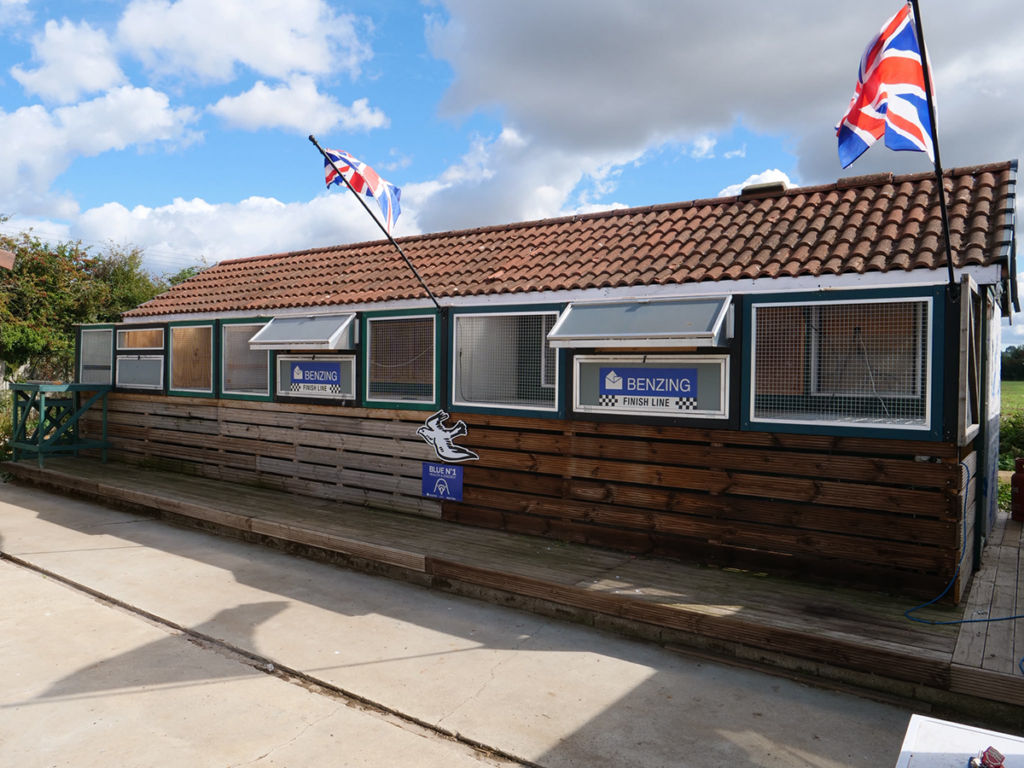
He is also one of our three members that have won the classic races both north and south, as he is also a Midlands National winner.
After a break in the sport, he certainly knocked the door down in this year’s Dunbar event when his blue bar cock, now named ‘Rock on Tommy’ lead the field by 50ypm.
This bird was one of 8 sent to Darren by his friend Jeff Fryatt of Stormont Lofts. These were placed into the young bird loft in April and is of Liederman, Leo Herman’s and Marcel Wouters breeding.
The birds were placed on the darkness system and taken off on the longest day. Darren is a hard task master and trains the youngsters every day and doesn’t free fly them once training commences. The sexes are not separated, he allows them the whole loft, scattering bowls around the pipi boxes around the place.
The youngsters are fed twice a day, in the morning they have a light feed with depurative with aniseed oil on and in the evening, the feed is a combination of breeding mix, kibbled maize, barley and homoform. Prior to the season, they are vaccinated using Columbovac and the usual routine treatments for worms, canker and respiratory. Should any further issues arise, Darren will contact Schroder Tollisan and Kevin Winter. Darren is a big fan of Kevin’s Botanical products.
Congratulations Darren and thanks to Ray Knight for providing the report.
Paul Crooks from West Bridgford –1st 2nd 3rd Section A, 14th 15th 16th Open
Flying: 220 miles, 361 yards. Velocity: 1471.6458
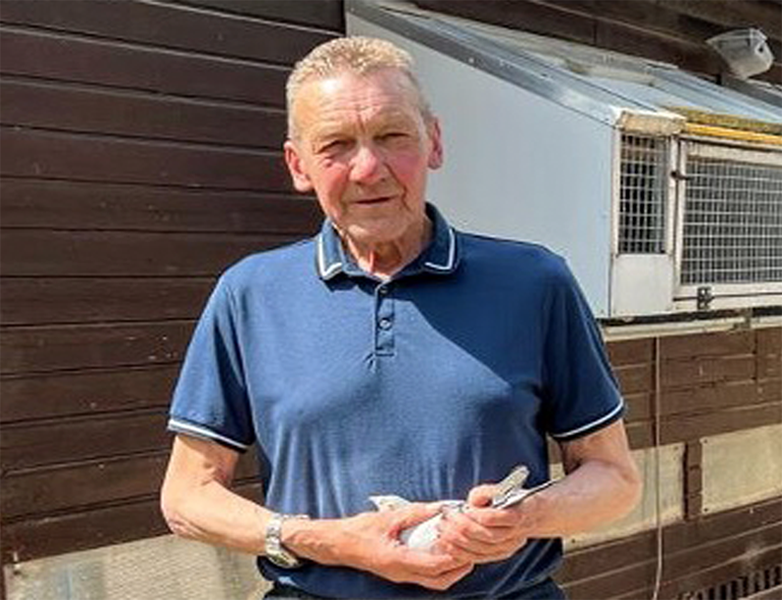
Paul Crooks, NRCC Chairman, only sent 8 birds and Paul was delighted to see how the birds came and brilliantly had his first three birds, all cocks, drop together, taking 1st, 2nd and 3rd Section A.
Paul’s 1st Section winner was bred from Hereman Ceuster bloodlines by Trevor Taylor of Gt Ayton (Marsay, Taylor and Robinson). Trevor Taylor also bred Paul’s 2nd bird. The 3rd bird dropping in was a new Belgian introduction that Paul is trying out, clearly proving to be successful.
Each fancier has his, or her, own methods of racing their birds, especially when it comes to youngsters. Paul races on the darkness system, April 30th – June 30th, with lights being used from the middle of July. The birds are kept together for the first two young bird races, then Paul parts them and they are exercised separately, with the hens tending to fly better than the cocks. On basketing day, the open door system is used from around 12pm.
Paul recognises there have been many young bird losses this year which in his opinion is mainly due to overcrowding, which then quickly leads onto health issues. Another factor he believes is training…or lack of it! In an ideal world, Paul believes the birds should be singled up but recognises that is not always possible, his own approach to training is Monday to Thursday, mostly early mornings with loft exercise in the evenings.
Well done Paul.
Ray Knight from Old Leake – 1st,3rd 4th, 7th, 8th, 9th, 10th Section C, 2nd, 4th, 5th, 20th Open
Flying 231 miles, 1213 yards. Velocity:1502.269
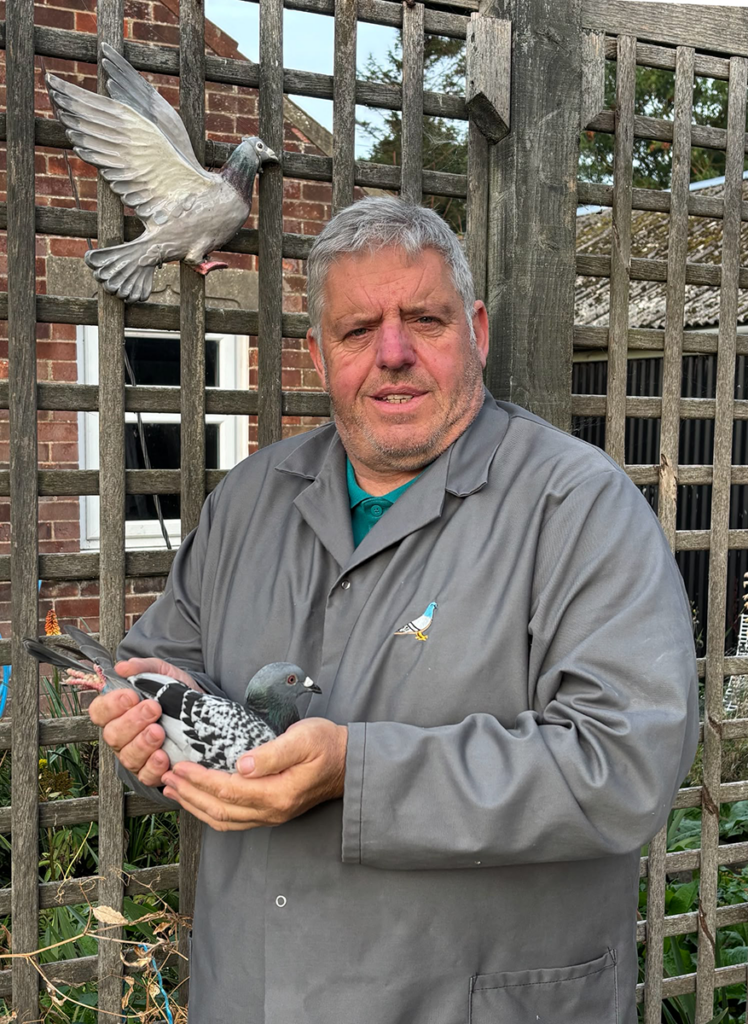
This is the name that is synonymous with the NRCC, Ray Knight, the NRCC’s 17th President.
Ray’s first bird topped Section C, taking 2nd Open, although the winning did not stop there, Ray had an incredible seven birds in the top ten of his section!
Ray thrives on young bird racing and is certainly an expert in the field. Ray’s 1st Section winner, a chequer cock, comes down from his own family of Leo Herman’s pigeons which he brought in 2010 directly from Belgium. These have been blended together with pigeons from Peter Fox and Ray’s old family from Lucien Geerts, and as Ray says, “I don’t have pure pigeons”.
Ray paired up around 14th February, which was later than he normally does, the youngsters were put onto the darkness system and were exercised when time allowed.
Due to work commitments, Ray’s pigeons have had to take a back seat this season, but as things at work started to quieten down, Ray decided this was the time to get his young birds going. Sadly, Ray then suffered two TIA’s resulting in him not being able to drive for just over a month, so more delay with the young birds.
This did not deter Ray and soon as he was able, he prepared his team of 43 young birds and sent them to his club’s third race, Darlington, a distance of 127 miles to him. When training starts, usually there is no loft flying for Ray’s youngsters. They then had two races and Ray thought things were getting back on track, when low and behold, the youngsters developed YBS on the August Bank Holiday weekend. Fortunately, Ray spotted this very early and had a chat with his good friend Bob Fenech and between them they got the birds turned around.
The following week, Ray sent them to Darlington again, entering 41 birds. He had 10 on the drop and two minutes later he had another 10 on the drop. The clocks were done at midday and at that point, Ray had 38 out of his 41 he had sent.
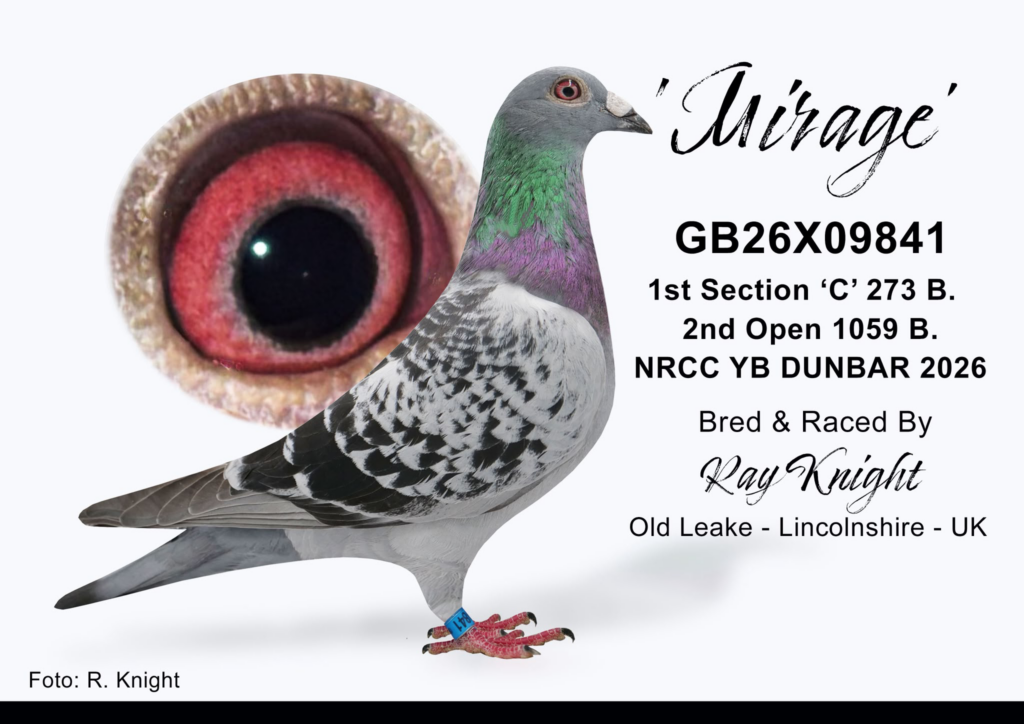
With the NRCC Dunbar YB race just one week away, Ray’s work commitments allowed time for only three more training tosses; on the remaining days, the birds had to be exercised around the loft.
Ray sent 38 to the race, he clocked 31 on the day, 5 came the next morning and one hen came on Tuesday, she had bumped the wires.
Ray’s youngsters weren’t separated this year, they were left to run together. They are fed on Ray’s own mixture that he has produced by Bamford’s and the birds are given the same mixture, twice a day, every day apart from the day of basketing when the birds only have one feed.
Ray would like to congratulate club mates Darren Peters on his Open win and Joe McFadyen on 3rd Open.
On a final note, Ray would like say “I should close by mentioning everyone behind the scenes in the NRCC, for their support and work done for the club, as while the members have had great racing, things this year have certainly been testing at times and on that note, let’s look forward to a good get together at Springfields on Saturday 28th November, at the Day of Champions”.
Well done Ray.
A & O Clarke from Forty Foot Bank, Chatteris – 1st Section E, 76th Open
Flying: 263 miles, 1288 yards. Velocity: 1390.8470
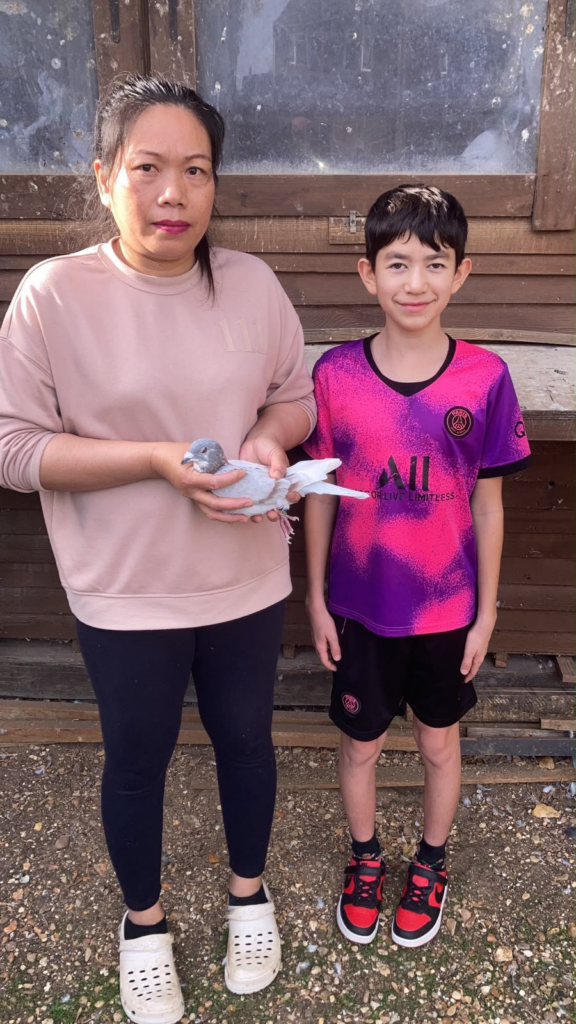
Alan and Orawan Clarke are absolutely thrilled to be topping their section again, this is the second time this year they have topped their section, the first section win for them was from Arbroath. With this being only their second season flying with the NRCC that is a fantastic result. This is a true family partnership, Alan trains the birds, Orawan is at home waiting for them and son Jim always around the lofts when he can. Alan starts training at 4 miles then progresses them to Sleaford which is 35 miles to them. Alan acknowledges that racing pigeons isn’t a cheap hobby once you take training costs and feeding, but luckily he has an electric car so that
has helped with the costs. Alan and Orawan’s birds are fed a mixture of conditioner and Bamford’s Super Fly.
Alan and Orawan’s first bird comes from their Van Den Bulck lines, they sent 26 birds to Dunbar and all 26 returned, which is superb considering the YB losses fanciers have seen this year.
Well done Alan, Orawan and Jim.
Tom Burkill from Mattishall – 1st 2nd 3rd 4th 5th Section F, 6th 7th 8th 9th 10th Open
Flying: 271 miles, 1400 yards. Velocity: 1474.0792
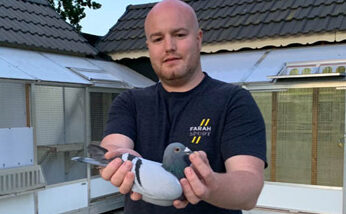
I asked Tom for some words for my report, Tom sent me a superb write up and is best copied straight from Tom:
Winning races has always been special, but this season has probably been the most enjoyable I’ve ever had in pigeons because it struck the balance perfectly.
After stepping down my involvement over several years away from breeding and latterly racing to focus on family life and growing the businesses, I honestly wasn’t sure whether I’d return. Like many people, I thought I was simply taking a break and concentrating on other priorities, but the reality was that the sport leaves a gap when it’s no longer there. No matter how busy life became, I found myself missing the anticipation of race day, the competition, and above all the time spent around the birds.
What I probably missed most was the release it gives you. In family and business, there are always decisions to make, problems to solve and demands on your time. With pigeons, for those few hours on race day, everything else disappears. Your entire focus is on the birds and waiting for that first speck to appear on the horizon. There aren’t many hobbies that allow you to switch off quite like that.
The opportunity to come back arose through my good friend Lee Beaumont of Barnsley. During my time away from racing, Lee had looked after a large number of my retired racers and had also housed more than five years’ worth of latebreds bred from the very best of my stock birds. Every year I continued pairing up and breeding a select number of youngsters from my proven pigeons, with Lee keeping them for me while I was out of the sport. Big thanks much also go to my Dad, Dave Burkill who, along with Lee, had a huge part to play in the season, starting with the rearing of exceptional babies, and it was great to see his enthusiasm for the pigeons is still as strong as ever.
Earlier this year, Lee offered me the chance to race the third round of those youngsters from May onwards. The plan was for them to be raced hard through the young bird season and those with performances attached to them would be sold through Les Green’s Northern Premier Pigeon Auctions, and that’s exactly what will happen with the sale commencing mid October giving people chance to collect birds from Doncaster if they would like to save a bit of carriage cost.
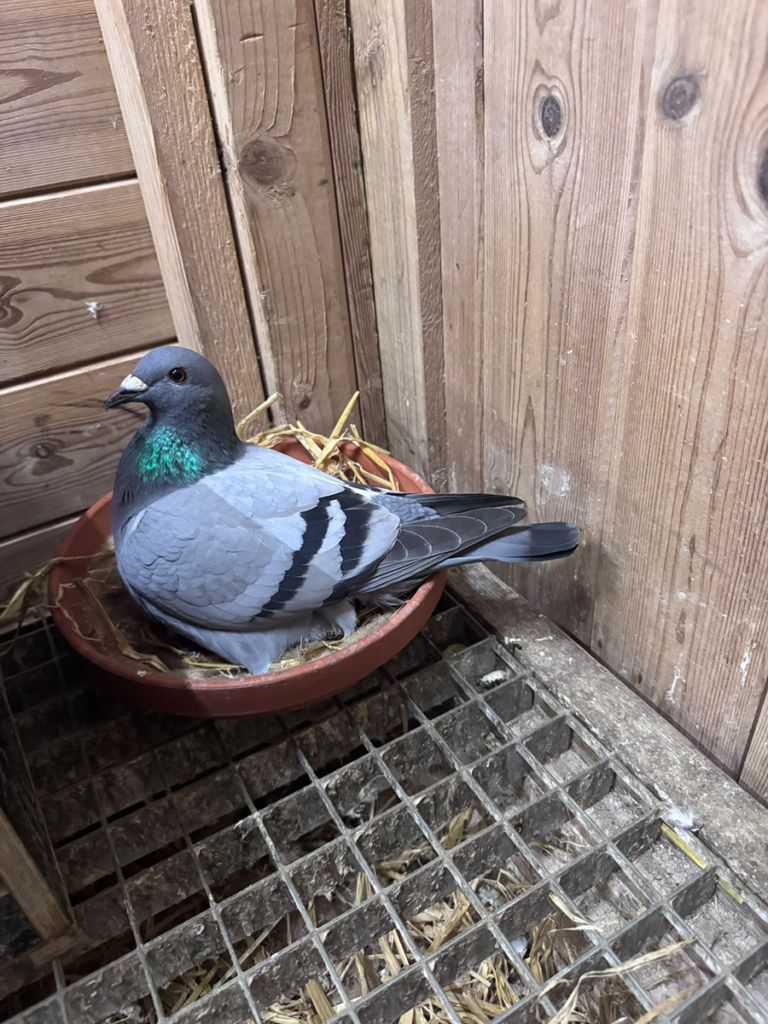
The birds themselves are predominantly based around the Van Den Bulck bloodlines from Les Green (and one Gem from Ronnie Johnson), crossed with James Dutton’s exceptional Alex Docx family and Ian Staffords phenomenal Lincia family. They have shown quality from the very beginning, but what has pleased me most is not just the individual winners. Several loft mates have trapped together at the top of the Federation week after week (including first 20 in the fed
and first 10 twice), suggesting there is genuine depth and consistency within the team rather than reliance on one outstanding pigeon. I won at least one of the two clubs I split the team between if not both for 7 of the 8 weeks of the season.
My approach is relatively straightforward and certainly not overcomplicated. The birds are raced naturally, which this year with them being so young was a bit more of a challenge in terms of nest positions for the big races but they are just expected to enjoy being pigeons. I believe good pigeons in good health will do most of the work for you. Feeding is based around quality corn, with the mixture increasing in richness as the races become more demanding. Training has been kept sensible, with a focus on keeping the youngsters keen and confident rather than overworking them.
The biggest lesson I’ve learned since returning is probably that simplicity often wins. Having stepped away and come back without any of the help from my good friend David Hicks I needed a much fresher and more time manageable perspective. I’m less inclined to chase every new idea and more inclined to trust good pigeons, good breeding and careful management.
Results wise, the season has exceeded all expectations. To finish off by topping Section F, having 5 in the top 10 of the Open, first 5 in the section with Mr Hicks having one split the 6 that I got drop together was amazing, but then the team just kept coming with 14 in the top 20 of the section etc. Huge congratulations to the NRCC team for such a great race both in the main race and the futurity race where thanks to the help of Kevin Spiers for breeding the pigeon we were able to win 2nd and a nice draw to boot.
Looking ahead, I still have no desire to race old birds. Family and business will always come first. In many ways, the break helped me realise that balance is important. Perhaps six months on and six months off is the perfect answer. It gives me enough time to enjoy the sport, satisfy the competitive instinct, and experience that excitement of race day, while still maintaining the balance that life requires. So, same again next year.
If that’s what keeps me involved and enjoying my pigeons for many years to come, then I think I’ve found the perfect formula.
Well done Tom, taking 7 places in the first ten of a notoriously difficult Section F is no mean feat, great to see you back in the sport and thanks for a great write up.
G W Chalkley & Son from Forest Gate –1st Section H, 219th Open
Flying: 324 miles, 1537 yards. Velocity: 1285.5374
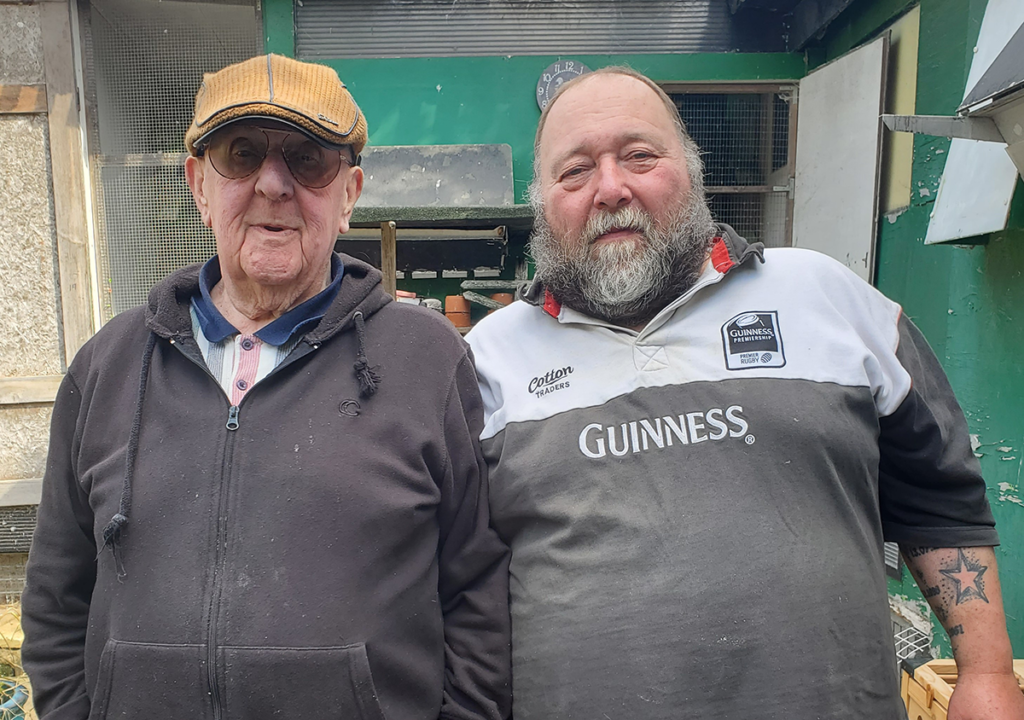
The fantastic partnership of George and Steve Chalkley sent 6 young birds and got an incredible three birds on the day with the other three birds dropping in the next day. Let’s just remind ourselves how far George and Steve race again…324 miles, 1537 yards, absolutely brilliant result.
Their first two pigeons dropping in are John Wills Wescott based nest mates from a Westcott cock and an Alan Parker hen.
They have already won prizes and cards from Darlington, great things to come from these two I think!
Well done Georgie and Stevie, an absolute superb result.
D Wilton & Son from Chadwell St Mary – 1st Section I, 91st Open,
Flying: 335 miles, 95 yards. Velocity: 1371.2774
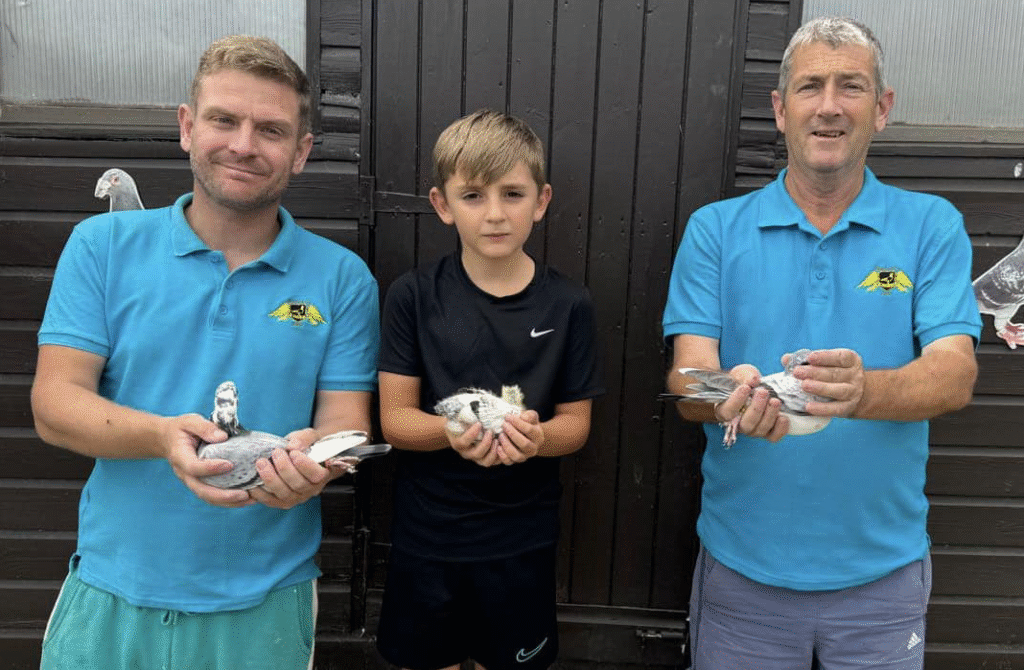
Another superb partnership flying 335 miles is Team Wilton, clocking their first pigeon at 17:10 then thirteen minutes later they clocked 3 birds on the drop. Following this they then had a couple more drop in enabling them to take the first six in the section.
Their first bird, a young hen was raced using the sliding door, cocks and hens separated then they are let run together before basketing for the race. She is bred mainly from their old Jansen bloodlines with a bit of Leo Heremans thrown into the mix. Her pedigree goes back to some of their top breeders from a few years back, out of super national racing hen, Miss Consistent from 2010, their old x14 1st prize sprint winner Self Harm from 2007 and their top Leo Heremans cock Golden Leo from 2013, none of which are with them anymore.
Team Wilton only road train their youngsters now, they don’t let them out around the loft anymore as the peregrine was hitting them every time the were let out. They train most mornings, Monday to Thursday to around 60 miles. The birds are fed on Versele Laga mixes, Super Star Plus and their own young bird mix, mixed together.
They use the darkness system with their young birds, which they have done for the last twenty years as they feel that is a far better way to enable them to race competitively without having to worry about the moult when the later races come around.
I asked if there was anything more they would like to see from the NRCC, they didn’t think anything needed to be done differently with the birds, they say the birds always come home in an amazing condition from all the NRCC races and the birds clearly get well looked after on the transporter and that’s the most important thing.
Well done Robbie and Andrew, fantastic result.
So that concludes the report for the first of the three races, the Old Hen Race Report will follow shortly, along with the Futurity Race. Thanks again to Ray Knight for writing the report for Darren Peters.
To view the full result please click here