A Blue Riband Race. A Committee Under Pressure. A Sport Built on Commitment.
There are races that fill the fixture list, and then there are races that define a season. The King George V Cup is one of those races.
For 125 years this Blue Riband event has represented everything that is great about long-distance pigeon racing. It is steeped in history, beginning in Lerwick in 1901 during one of the most remarkable periods in Shetland’s history. While the famous herring boom transformed the islands and thousands of fishermen crowded the harbour each summer, another tradition quietly began, a race that would become one of the most prestigious tests in British pigeon racing.
Every year, competitors dream of winning it.
Every year, the committee carries the responsibility of making it happen.
This year, that responsibility would be tested more than anyone could have imagined.
As race week approached, the weather forecasts became increasingly concerning. Every update suggested the same uncomfortable possibility—that the journey to Lerwick could prove futile, the birds might have to be brought home, and the King’s Cup itself could face cancellation.
For any committee, that is the decision nobody wants to make.
Behind every forecast were 141 competing members, two guest organisations, five marking stations, transport arrangements, ferry bookings, drivers, convoyers and months of preparation.
Yet despite the pressure, there was no panic. President Ray Knight instructed that two independent weather reports be obtained—one on Sunday evening and another on Monday evening. Every committee member was contacted personally by Chairman Paul Crooks to ensure every opinion was heard before an online meeting was held.
The discussion was thorough and the decision was difficult!
When the votes were counted, the committee voted twelve to six to postpone.
It was not a popular decision for everyone.
But leadership is not about making the easiest decision—it is about making the right one.
The welfare of the pigeons has always been, and always will be, the committee’s first priority.
If anyone imagined postponing the race made life easier, nothing could have been further from the truth. In reality, the hardest work had only just begun.
Every competitor had to be contacted and offered the opportunity either to transfer their entry or receive a refund. Manual entries received text messages, online competitors were emailed, and social media was updated to ensure nobody was left uninformed.
The marking stations had to be rebooked.
Drivers reorganised.
Transport rescheduled.
Accommodation rearranged.
Ferry crossings renegotiated.
What looked like a simple postponement from the outside became an enormous logistical operation behind the scenes.
Then fate dealt another blow!
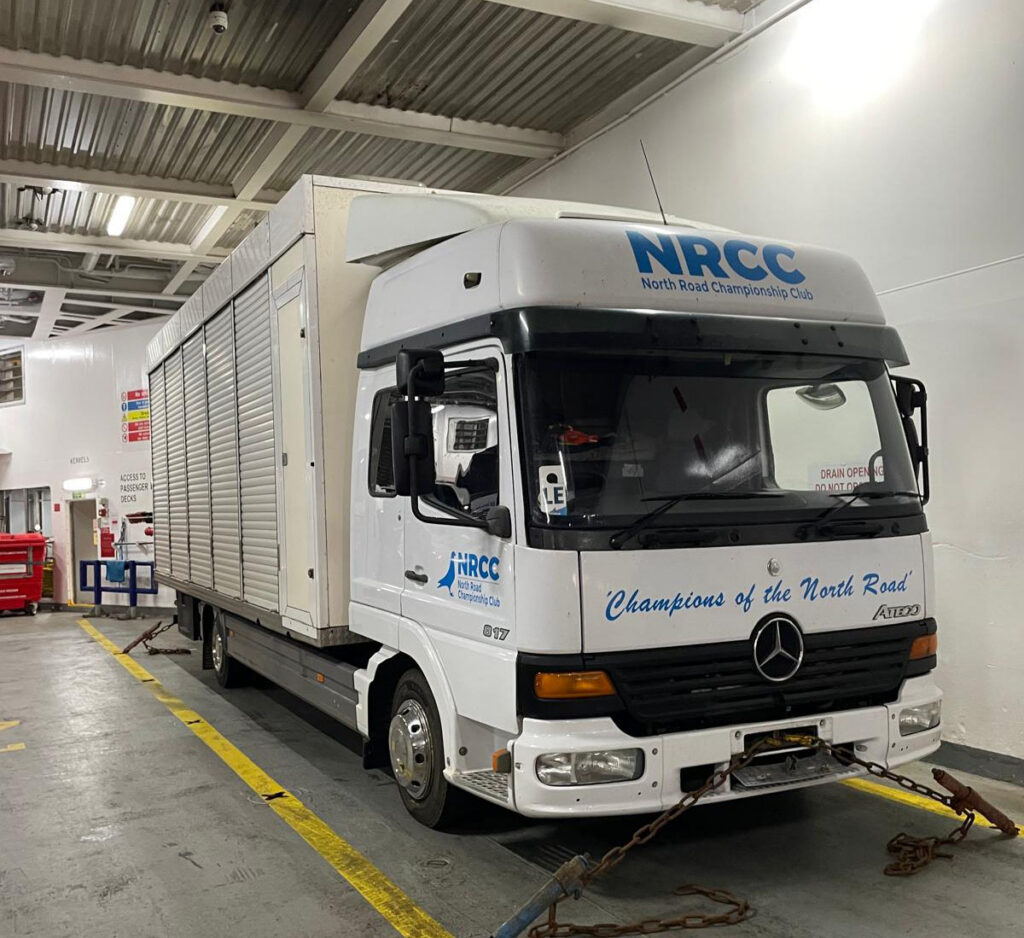
Driver Merv, originally scheduled for Lerwick, was unavailable for the revised date. Without hesitation, Chris Johnson stepped forward, sacrificing his own weekend to ensure the transporter could still make the journey.
Then, with barely twenty-four hours remaining before marking, another crisis struck.
Convoyer Dave Pettitt was forced to withdraw because of personal circumstances.
For a brief moment, the race itself seemed in jeopardy.
This was not a local club race where replacements are easily found, this was the King’s Cup.
One of the most prestigious races in the country.
Phones immediately began ringing.
Committee members contacted friends, region secretaries and experienced convoyers across the sport.
Everyone wanted to help.
Then came the call that changed everything, Brian Garnham contacted Tony Meek. Tony’s reply needed no deliberation. “I’d love to. It would be an honour.”
Those simple words captured everything that pigeon racing is about, Service, Commitment and Pride.
The National Flying Club convoyer Chris Withers, although already committed elsewhere, expressed exactly the same willingness to help had he been available.
Behind the scenes, Dilys King, NRCC Administration Secretary, together with Janine Newland of the East Midlands Region and David Higgins of the North East Region, worked tirelessly to ensure Tony’s convoyer’s licence was processed in time.
Meanwhile, Magnus Dixon and the team at NorthLink Ferries somehow managed to find space for the transporter aboard the MV Hjaltland during one of their busiest periods of the year, even upgrading the crew’s accommodation for the long journey north.
By Tuesday afternoon—less than twenty-four hours before marking—every obstacle had been overcome.
Against all the odds…
The King’s Cup was back on and what a race it turned out to be.
The eventual result produced plenty of discussion and even surprised some of those who had questioned whether postponing the race had been the correct decision.
But perhaps the greatest success wasn’t who won the race.
It was that the race was flown at all.

In every sport there are critics
People see a date change, they see a result and they see the headlines.
What they rarely see are the countless hours of unpaid work, the difficult decisions, the endless phone calls, the volunteers who give up weekends with their families, or the committee members who shoulder enormous responsibility knowing that whatever decision they make, someone will disagree.
Committees are often judged by the decisions people don’t understand rather than by the disasters they quietly prevent.
This year’s King’s Cup is proof of that.
Because this was never simply about postponing a race.
It was about protecting the welfare of the pigeons.
It was about safeguarding the reputation of one of the sport’s greatest events.
It was about hundreds of competitors who deserved every opportunity to compete under the best conditions possible.
Most of all, it was about a group of volunteers who refused to let 125 years of history be defeated by circumstances beyond their control.
The easiest decision would have been to do nothing.
Instead, they chose to do everything.
So, before questioning the commitment of those who serve on committees, remember this story.
Remember the sleepless nights.
Remember the phone calls.
Remember the volunteers who stepped forward without hesitation.
Remember that behind every successful race is a team of people who ask for little recognition but carry enormous responsibility.
The King’s Cup has reached its 125th year because generations of dedicated people have protected it, often quietly and without reward.
This committee has simply added another proud chapter to that remarkable story.
To every volunteer, every official, every driver, every convoyer, every helper and every competitor who placed their trust in the process—thank you.
Because in the end, it wasn’t just the King’s Cup that won.
The spirit of pigeon racing did too.
Ray Knight
President